Showing posts with label Church book club. Show all posts

Monday, October 25, 2010

My Soul To Take by Rachel Vincent

My Soul To Take is this month's read for my church book group.  A couple of the women in my group had read it before it was suggested a couple of months ago, and their enthusiastic responses about the book were all it took for me to want to read it.  Unfortunately, I didn't enjoy the book as much as they had, and from the Goodreads reviews of other women in my book group, it appears that we have the full spectrum of opinions about the book this month.  Some loved it, some thought it was okay, and some just plain liked it.  I fall in the latter group.

My Soul to Take (Soul Screamers, #1)Starting out, I had a difficult time getting into the book because I just didn't have much time to read, and I didn't find what I was reading all that interesting.  I read the first 50 or so pages over a span of 3 days, and had to reread pages to remember what was happening.  The story itself is intriguing:  16-year-old Kaylee Cavanaugh senses when people around her are going to die.  When the premonitions of death overcome her, she begins uncontrollably screaming at the top of her lungs.  Kaylee doesn't know why she senses death, and she's afraid to tell her aunt and uncle about it because they had her committed to the psych ward of the local hospital the last time she screamed like that.  When three teenage girls suddenly drop dead on three different days, with two of the deaths 'predicted' by Kaylee, Kaylee knows something is amiss.  She overhears her aunt and uncle talking about her, and realizes they're keeping secrets - they know why she screams.  With the help of hottie Nash Hudson - who curiously seems to know so much about her experiences - Kaylee learns the reasons why she has the screaming attacks, as well as the history behind them.

I enjoyed My Soul To Take, but it obviously wasn't a book I couldn't put down.  I truly liked the characters (there wasn't a single character I had a problem with, which is unusual), and the mythology behind the story is really interesting, but it took me a long time to get into the book.  I admit, though, that the last 35 pages left me intrigued enough to possibly want to continue with Kaylee's story.

My rating: 3.5/5 (and the extra .5 is because of the ending!)

P.S. There is a prequel novella to My Soul To Take, called My Soul To Lose.  I haven't read it yet, but I found it online, and I will most likely read it, if only to get a bit more backstory on Kaylee.

My Soul To Take is #1 in the Soul Screamers series.

Thursday, August 26, 2010

Church book group: Ender's Game and Fallen

Last night my church book group met to discuss Ender's Game.  I read it way back in 2006 (see my review here), and while I didn't feel like completely re-reading it  (I had other things to read...like Mockingjay), I did find the time to read some summaries online and go over the last few chapters of the book again to refresh the story in my mind.  We had a great discussion--one of our best yet.  Not everyone loved the book like I did (although a couple of women did), but it got pretty good reviews from the other gals.

Fallen (Fallen, #1)
Anyway, someone asked what next month's book, Fallen, is about, and since I've read it already, I decided to give a little summary of sorts.  But for the life of me, I couldn't remember a single thing.  A couple of the other women are reading it now, and one other has already read it, so I asked them to tell me the names of the main characters in hopes that I could remember something.  (I've been so anxious for Mockingjay to come out that everything else has leaked from my brain, it seems.)  To make sure that I have at least one resource to look back on next month when book group comes around, I decided that I should write my Fallen review before I completely forget everything about the book.  As it is, I don't remember much, which is quite sad, considering I read it a little over a week ago.

I'll just go ahead and use the synopsis from the back of the book, since I don't feel any summary I write will do the book justice:

There's something achingly familiar about Daniel Grigori.

Mysterious and aloof, he captures Luce Price's attention from the moment she sees him on her first day at the Sword & Cross boarding school in sultry Savannah, Georgia. He's the one bright spot in a place where cell phones are forbidden, the other students are all screw-ups, and security cameras watch every move.

Even though Daniel wants nothing to do with Luce—and goes out of his way to make that very clear—she can't let it go. Drawn to him like a moth to a flame, she has to find out what Daniel is so desperate to keep secret . . . even if it kills her.

Dangerously exciting and darkly romantic, Fallen is a page turning thriller and the ultimate love story.

I found another synopsis online that gives a better feel for the book, but it is definitely spoiler-ish, so highlight it if you'd like to know more about Fallen:

Seventeen-year-old Luce is a new student at Sword & Cross, an unwelcoming boarding/reform school in Savannah, Georgia. Luce's boyfriend died under suspicious circumstances, and now she carries the guilt over his death with her as she navigates the unfriendly halls at Sword & Cross, where every student seems to have an unpleasant, even evil, history.


It's only when she sees Daniel, a gorgeous fellow student, that Luce feels there's a reason to be here though she doesn't know what it is. And Daniel's frosty cold demeanor toward her? It's really a protective device that he's used again . . . and again. For Daniel is a fallen angel, doomed to fall in love with the same girl every 17 years . . . and watch her die. And Luce is a fellow immortal, cursed to be reincarnated again and again as a mortal girl who has no idea of who she really is.

I wanted to like Fallen a whole lot more than I did.  I waited and waited for something to happen, but the story dragged on so slowly.  Fallen has a very interesting premise, but it took far too long for anything to happen.  I know it's the first book in a series, but come on.  The last 100 pages (out of 452), when we find out Daniel and Luce's story, are what made the book enjoyable for me, and it's those last chapters that make me eager to read Torment when it comes out.  I really hope things work out for Luce and Daniel!

3.25/5

Thursday, November 12, 2009

The Boy in the Striped Pajamas by John Boyne

The Boy in the Striped PajamasNine-year-old Bruno is naïve, an explorer and dreamer. He doesn't understand why he has to leave his comfortable 5-story home in Berlin for a smaller 3-story house in Out-With. It all started when the Fury came to dinner. Now Bruno's dad has a sharp new uniform and soldiers everywhere are calling him "Commandant." And just what is with the fence in Bruno's yard? And are those people he sees behind the fence? People in striped pajamas? On one of his explorations he comes across a "dot that became a speck that became a blob that became a figure that became a boy." A boy Bruno's age, a boy wearing those striped pajamas. And, through that barbed wire fence, a friendship forms between Bruno and Shmuel, the boy in the striped pajamas.

This book is somewhat hard to review. I have mixed feelings about it. I realize that Bruno is naïve for his age, but you'd think that he'd be just a bit more knowledgeable about the events in his life considering his father was such a high-ranking official in the Nazi party. I read a book called Hitler Youth a couple of years ago, and learned that German children were taught to hate Jews and to follow Hitler's every command from a very early age, so I don't understand why Bruno couldn't even pronounce "Führer" correctly, let alone know absolutely nothing about the Jews. Even with those complaints, I found the story quite interesting. It was intriguing to read about the Holocaust from a nine-year-old's perspective. A very sheltered nine-year-old, but a nine-year-old all the same. And while this isn't a book with a happy ending, I feel the ending was perfect.

I look forward to my book club's discussion next week. There has been quite the spectrum of ratings from members of my book club on Goodreads, so it will be interesting to see why everyone gave the ratings they did. I also look forward to seeing the movie, hopefully sometime soon. Maybe even before book club so that I can compare the two.

3.5/5

Monday, March 16, 2009

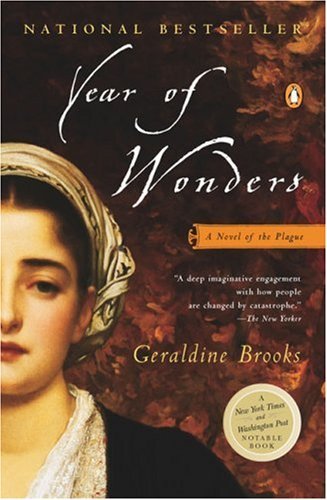
Year of Wonders - Geraldine Brooks

Year of WondersIn Year of Wonders, Geraldine Brooks describes the far-reaching effects of bubonic plague on a small English village in the year 1666. Anna Frith, an 18-year-old widow, is the narrator of this sad tale. Needing to earn extra funds to provide for her young sons after the death of her husband, Anna takes in a boarder, a tailor who unknowingly carries the plague in the bolts of cloth he works with. On his deathbed, the tailor warns Anna to burn everything he brought with him, now perceiving the cloth to be the culprit of his illness. Anna, though, allows the villagers to take the items the tailor had worked on, feeling she has no right to withhold them from those who had already paid for his labors. This decision would play a part in deaths of two-thirds of the villagers.

The local vicar urges the villagers to quarantine themselves, lest the plague spread to other towns in the area. The confinement and constant death leads to madness among the villagers, who take matters into their own hands, accusing some of witchcraft and exploiting and murdering others. Anna, the minister, and his wife, must overcome their own fears to help those suffering around them, even though Anna herself loses those closest to her.

The horrors depicted in Year of Wonders held my attention. I found myself appreciative that I haven't had to witness such suffering and affliction. And I thought a lot about not only how terrible the plague must have been, but how difficult everyday life itself must have already been, without adding the plague to the mix. The story is a compelling one, and Anna lends a courageous voice to it. In brushing aside her own grief, she helped others who had nowhere to turn and no one to turn to. And the year of plague became a year of wonders for her, as she grew in strength and knowledge.

3.5/5

Friday, November 7, 2008

The Lace Reader - Brunonia Barry

Look into the lace . . . When the eyes begin to fill with tears and the patience is long exhausted, there will appear a glimpse of something not quite seen... In this moment, an image will begin to form . . . in the space between what is real and what is only imagined.

Can you read your future in a piece of lace? All of the Whitney women can. But the last time Towner read, it killed her sister and nearly robbed Towner of her own sanity.

Towner Whitney, a dazed young woman descended from a long line of mind readers and fortune tellers, has survived numerous traumas and returned to her hometown of Salem, Mass., to recover. Any tranquility in her life is short-lived when her beloved great-aunt Eva drowns under circumstances suggesting foul play. Towner's suspicions are taken with a grain of salt given her history of hallucinatory visions and self-harm. The mystery enmeshes local cop John Rafferty, who had left the pressures of big city police work for a quieter life in Salem and now finds himself falling for the enigmatic Towner as he mourns Eva and delves into the history of the eccentric Whitney clan.

The Lace Reader was definitely a strange book, with many different layers to it. Towner is the main voice of the book, but the reader can never be sure if what is happening is real or imagined, given Towner's history of hallucinations and time spent in a mental hospital. Amongst witches and religious fanatics, Towner and Rafferty are on quest to discover what happened to Eva, taking the reader on a bizarre ride, full of mysterious and peculiar goings-on.

I can't say I loved this book, but I enjoyed it to a certain extent. Once I got the hang of how the story was being told, I enjoyed it more. It took me some time to get into the story at first because it was all so confusing, trying to keep things straight. And even when I thought I had things figured out, I discovered I was wrong. The ending was so unexpected; I liked that. And I loved Rafferty. I wouldn't mind reading more about the characters in The Lace Reader. If Brunonia Barry ever decides to write a sequel, I just may read it.

Also, having just read The Heretic's Daughter, which was also set in Salem, albeit during the witch trials of the 1600s, I more fully understood the history of Salem and all the talk about witches in The Lace Reader. I couldn't have read the two books at a more opportune time, I guess.

3.5/5

Friday, October 17, 2008

Life of Pi - Yann Martel

Life of Pi is the book for my church book group this month, and listening to some of the other women talk about it made me a bit hesitant to pick it up and read it. Once I got into the story, though, I really liked it. Not only is it a fascinating read, it's also very well written.

Pi (short for Piscine, as in the French word for 'swimming pool') Patel is 16 years old when his father sells the family zoo in Pondicherry India to start a new life in Canada. The family boards a ship, the Tsimtsum, with some of their zoo animals, eager to begin their journey. A couple of days later, the ship sinks, taking with it every living thing that was onboard -- with the exception of Pi, Richard Parker the Bengal tiger, a hyena, an orangutan, and a zebra. This motley crew float away on a lifeboat with rations enough to last Pi about three months. Pi is understandably worried about being eaten by the hyena or Richard Parker, and doesn't know how he'll survive with the animals aboard. The hyena eats the zebra and the orangutan, and then Richard Parker eats the hyena, leaving himself and Pi as the sole occupants of the lifeboat. Pi says:

I was alone and orphaned, in the middle of the Pacific, hanging on to an oar, an adult tiger in front of me, sharks beneath me, a storm raging about me. Had I considered my prospects in the light of reason, I surely would have given up and let go of the oar, hoping that I might drown before being eaten. But I don't recall that I had a single thought during those first minutes of relative safety. I didn't even notice daybreak. I held on to the oar, I just held on, God only knows why. [p. 107]

Pi survives (I'm not giving anything away; the reader discovers this right away), with one whopper of a story to tell.

I survived 227 days. That's how long my trial lasted, over seven months. . . . I survived because I made a point of forgetting. My story started on a calendar day--July 2nd, 1977--and ended on a calendar day--February 14th, 1978--but in between there was no calendar. I did not count the days or the weeks or the months. Time is an illusion that only makes us pant. I survived because I forgot even the very notion of time. [p. 191-192]

The ending really surprised me, in a good way. Pi tells his story to two members of the Maritime Department in the Japanese Ministry of Transport. The men have been sent to question Pi, hoping to discover what happened to make the Tsimtsum sink. They never forget the story they heard.

I can't say much more without giving something away, but I can say that I really liked this book. That Pi survived is incredible. And his story is pretty incredible, too.

4/5

Monday, September 22, 2008

The Princess Bride: S. Morgenstern's Classic Tale of True Love and High Adventure - William Goldman

Fencing. Fighting. Torture. Poison. True love. Hate. Revenge. Giants. Hunters. Bad men. Good men. Beautifulest ladies. Snakes. Spiders. Beasts of all natures and descriptions. Pain. Death. Brave men. Coward men. Strongest men. Chases. Escapes. Lies. Truths. Passion. Miracles. The Princess Bride has it all!

Yes, there is a movie of the same name, and yes, it is the same story--the story of Westley, the heroic "Farm Boy" turned pirate, and Buttercup, the dim-witted milkmaid turned princess. Westley and Buttercup fall madly in love. It's funny how it all comes about, really. Buttercup, having spent her entire life either yelling at or completely ignoring Westley, the farm boy who helped with the chores, all of a sudden realizes that she's head over heels for him (it took a beautiful Countess looking at him "that way" for her to even care). So Buttercup finds Westley in his "hovel" and declares her undying love for him. And Westley slams the door in her face. Hilarious. After letting her stew for the day, Westley tells Buttercup that he's leaving to make his fortune in America so that he can provide a good life for her. Buttercup doesn't understand. She asks him if her loves her. And he replies:

Do I love you? My God, if your love were a grain of sand, mine would be a universe of beaches. . . . I have stayed these years in my hovel because of you. I have taught myself languages because of you. I have made my body strong because I thought you might be pleased by a strong body. I have lived my life with only the prayer that some sudden dawn you might glance in my direction. I have not known a moment in years when the sight of you did not send my heart careening against my rib cage. I have not known a night when your visage did not accompany me to sleep. There has not been a morning when you did not flutter behind my waking eyelids. [p.57]

*swoon* I wish someone would talk to me like that!

Thus begin the adventures of Westley, Buttercup, and the rest of the gang: Prince Humperdink of Florin, the man who claims to love Buttercup, but who really wants power, and thus plots to have Buttercup murdered, placing the blame on the neighboring land of Guilder; the Sicilian criminal Vizzini, who will do anything for gold; the gentle giant Fezzik; Inigo Montoya, on the search for the six-fingered noble who killed his father; and the evil Count Rugen.

I'm sure most of you have seen the movie version of The Princess Bride. I saw it a couple of times when I was younger, but didn't much like it. I really don't remember why I didn't like it, but I definitely need to watch it again (I already have it on hold at the library) because I LOVED the book! I absolutely loved it, and didn't want it to end. It was funny and action-packed and wonderful.

What's truly amazing, though, are the layers to this story. William Goldman claims that this is just an abridgement of the "good parts" of The Princess Bride: A Classic Tale of True Love and High Adventure, written by S. Morgenstern, which his father read to him as a boy. He told the whole backstory about this Florinese author S. Morgenstern, who wrote The Princess Bride about the history of his country. But none of it is true. Goldman made it all up. He's the actual author of The Princess Bride; there is no S. Morgenstern. I wouldn't have known that had I not read it elsewhere! Goldman is very good at convincing the reader that all he's doing, really, is abridging Morgenstern's original book. It's brilliant.

So, as I said above, I loved The Princess Bride. I think a big part of that has to do with the fact that I could only vaguely remember what happens in the movie; so reading the book was like experiencing everything for the very first time. Some friends have told me that the book is exactly like the movie, and they therefore didn't likethe book as much as they do the movie, so I'm glad that I (kind of) read the book "first"--or at least forgot enough about the movie so that it felt like I read the book first!

5/5

Friday, April 25, 2008

The Book Thief ~ Markus Zusak

With Death as narrator, Markus Zusak's haunting novel follows Liesel Meminger, The Book Thief, through the fear-filled years of Nazi Germany. The story opens as the ten-year-old girl takes her first book shortly after her younger brother's death. Both children were en route to the foster home of Hans and Rosa Hubermann in a Munich suburb. Despite Rosa's sharp tongue and Hans's lack of work, their home is a loving refuge for the nightmare-ridden girl. It also becomes a hideout for Max, a young Jewish man whose father saved Hans's life. Liesel finds solace with her neighbor Rudy and her creative partnership with Max. Accompanied by Rudy, the girl copes by stealing food from farmers and books from the mayor's wife. There are also good moments as she learns to read and plays soccer, but Hans's ill-advised act of kindness to a Jewish prisoner forces Max to leave their safe house. The failing war effort and bombing by the Allies lead to more sacrifices, a local suicide and, eventually, to great losses. Reading books and writing down her experiences save Liesel, but this novel clearly depicts the devastating effects of war. With richly evocative imagery and compelling characters, Zusak explores behind-the-lines life in World War II Germany, showing the day-to-day heroism of ordinary people.

(I found it too difficult to write my own summary of this book, so I use the one above, courtesy of Barbara Wysocki of the School Library Journal.)

What can I say about this book? It was amazing, beautiful, haunting. I've never read anything like it. Seriously, I am at a loss for words. I honestly don't know how to review this book. I highly recommend that you read it yourself; then you'll understand why I'm having such a difficult time putting my thoughts down in writing. I finished the book last night, and am still thinking about it.

I admit that the first two-thirds of the book left me wondering just what was going to happen. As I was reading, I couldn't decide if I liked the book or not. But the last third of the book, when all my questions were answered, decided it for me. I ended up loving it.

The characters all wormed their way into my heart. Liesel, Rudy, Hans, Max, even Rosa (although Liesel, Rudy, and Hans were my absolute favorites.) The ending was sad, and I cried and cried. I didn't want the book to end. I wanted to spend more time with these characters that I had grown to love.

5/5